
CRM and Field Sales: Why Your Best Conversations Never Make It Into the System

Your top field rep just spent 20 minutes on the phone with a key prospect from their car, between two appointments. They identified the real decision-maker, mapped out the available budget, and committed to a follow-up call within 48 hours. For them, it's a major step forward in the deal. For your CRM, that conversation never happened.
This is the core paradox of modern field sales: your reps are more reachable than ever, and more disconnected from their own information system than ever. And the gap between what happens in the field and what your CRM actually contains is costing you more than you think.
Why CRM Data Gaps Aren't a People Problem
When sales directors are asked about the quality of their CRM data, the answer is almost universal: records are incomplete, call notes are bare-bones, and follow-up timelines are approximate at best.
The instinct is to treat this as a discipline issue. It isn't.
Field sales reps spend their days on the move. They call from their car. They reply to messages in car parks. They sometimes use their personal phone because it's the one in their hand. At no point during that working day do they have the time or the conditions to open a CRM and document every interaction with the level of detail the system expects.
The problem isn't willingness. It's infrastructure. The CRM was built for desk-based work. Field sales isn't desk-based work. The mismatch is structural, not behavioural.
And the outcome is mechanical: the most strategically valuable data the kind produced out in the field, in real commercial conversations never makes it into the system. What the CRM doesn't contain, you can't measure, manage, or build on.
The Real Cost of Missing Field Data
According to Salesforce's State of Sales report, the average salesperson spends only 28 to 35% of their time on actual selling.
The rest disappears into administrative tasks a significant share of which is tied directly to the manual entry of information that technology could capture automatically.
But the most invisible cost isn't lost time. It's the data that was never recorded.
When a rep leaves the company, they take with them everything the CRM never captured: the nuances of key conversations, the real objections prospects raised, the verbal commitments made, the preferences of long-standing clients. Their replacement starts from scratch. The relationship you spent months building has to be rebuilt from zero.
For the manager running a field team, operating without reliable CRM data is like navigating without instruments. Pipeline forecasts are built on the natural optimism of salespeople rather than on what was actually discussed. Investment decisions are made on assumptions. Coaching is based on perception rather than evidence.
For the business as a whole, every undocumented field conversation is a lost asset. Patterns that could inform product decisions, pricing strategy, or competitive positioning simply don't exist in the data because no one had the means to capture them in the conditions where they were produced.
The Personal Phone Risk Few Organisations Have Actually Measured
Field reps using personal phones for professional calls is widespread. It's understandable, it's convenient, and it represents a legal and strategic exposure that very few organisations have genuinely addressed.
From a GDPR standpoint, client data flowing through a personal phone stored in private contacts, exchanged via personal messaging apps falls entirely outside the company's compliance perimeter. In the event of an audit or a dispute, the exposure is real and difficult to defend.
Strategically, if a rep builds their contact list on a personal device, that list is their property, not the company's. When they leave, it goes with them. There is no contractual mechanism that reliably prevents this, because the data was never in the company's systems to begin with.
The answer isn't to prohibit field practices that reflect a legitimate operational reality. It's to give those practices an infrastructure that reconciles the agility of the salesperson with the traceability needs of the organisation.
What Telephony-CRM Integration Actually Changes for Field Teams
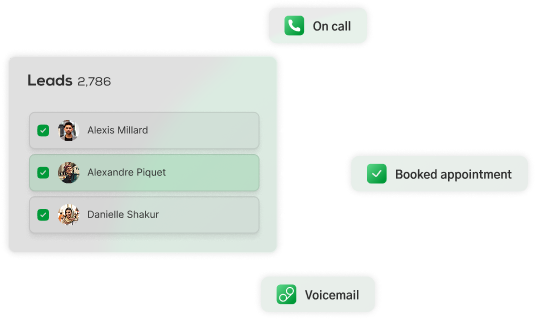
When telephony is integrated with the CRM, the field rep doesn't change their habits. They still call from their smartphone. They still answer on the go. The difference is that every call made through the professional app is automatically logged: duration, timestamp, number dialled and with AI-powered solutions, a transcription and summary generated at the end of the call.
The salesperson enters nothing manually. Strategic information no longer evaporates. The manager has a real-time view of field activity. And client data stays within the company, regardless of staff turnover.
This is what Un1ty makes possible through its professional mobile app: a clear separation between personal and professional use on a single device, with automatic background synchronisation to the CRM. The nomadic sales rep is no longer off the radar. They're connected to the central database without having to change anything about how they work.
Concretely, this means:
- Every field call becomes a traceable, searchable record
- Onboarding a new rep no longer means starting from zero on key accounts
- Forecasting is based on actual conversations, not subjective pipeline updates
- Compliance perimeter is maintained, even when the team is entirely mobile
Conclusion
Your field sales reps aren't flying under the radar because they don't want to document their activity. They are because the infrastructure doesn't give them the means to do so under the real conditions of their work.
Connecting mobile telephony to the CRM isn't a complex IT project. It's the foundational requirement for your information system to finally reflect the reality of your commercial activity and for every field conversation to become a company asset rather than lost data.
Every deal discussed on the road deserves to exist in your system. The technology to make that happen is already there.
👉 Want to go further? Download our strategic guide for Sales Leaders: Telephony & CRM: The Strategic Guide for Head of Sales
Unify your voice and data.
Test the power of connected telephony.

.png)
.png)
.png)
