
How Many Opportunities Is Your Real Estate Agency Losing Due to Poor Call Follow-Up?
.png)
Missed calls, forgotten information, follow-ups that never happen… In a real estate agency, every client conversation can contain a sales opportunity. But how many of them are lost because call follow-up is not structured enough?
In a real estate agency, the phone is everywhere.
A buyer calls to get information about a property. A property owner wants to know how much their home is worth. A prospect calls back after a viewing. A seller asks for an update on the marketing of their property.
These conversations are often the starting point for a sales opportunity.
Yet once the call ends, the information can quickly disappear: a note scribbled down in a hurry, a forgotten callback, information that remains in the agent's head, or a call that is never properly logged in the CRM.
The problem is therefore not only about missing calls. It is also about losing the value of calls that were successfully answered.
Why Is Call Follow-Up Such an Important Issue for Real Estate Agencies?
The phone remains a key sales channel
Despite the growth of online forms, property portals and social media, the phone remains central to agents' daily activities.
It is used to:
- qualify buyers;
- schedule appointments;
- arrange property viewings;
- communicate with sellers;
- negotiate;
- follow up with prospects;
- move transactions forward.
Every call can therefore represent a step in the sales journey. But unlike a web form, the content of a call is not automatically structured in the CRM. The information often depends on what the agent remembers to record after hanging up.
The most important information is not always the information that gets recorded
A CRM may contain:
- Budget: €350,000
- Property type: apartment
- Area: Toulouse city centre
But this is not necessarily enough to understand the project. During the call, the buyer may have explained that:
- they are now considering increasing their budget;
- they now prioritize having outdoor space;
- they need to sell their current property before buying;
- they want to move quickly;
- they have rejected two properties for a specific reason.
This information can sometimes be much more valuable for future follow-up. If it is not recorded, it disappears with the conversation.
Common Mistakes in Call Follow-Up
1. Not Calling Back a Missed Call Quickly Enough
This is the most obvious mistake. An incoming call may be:
- a valuation request;
- a viewing request;
- a buyer interested in a property;
- a property owner looking to sell.
When a call is not returned quickly, the agency risks missing an opportunity. But be careful: the missed call is only the first part of the problem. Even when an agent answers, follow-up may still be inadequate.
2. Relying on the Agent's Memory
After a day filled with property viewings, travel and dozens of calls, it is difficult to remember every conversation accurately. An agent may easily remember, “I spoke to Mrs. Martin yesterday,” without remembering, “She was hesitating between two areas and asked me to call her back after her meeting with the bank.”
Losing this context can have a direct impact on the quality of the client relationship.
3. Not Updating the CRM After the Call
The call took place, but nothing is added to the client record. A few days later, another team member takes over the file without knowing what was discussed.
The CRM exists, but it does not actually reflect the relationship with the client. This is a common situation when data entry is entirely manual.
4. Failing to Turn the Call Into a Next Action
A conversation may end with: “I'll take a look at what I have and call you back.” But if no task is created, the callback can easily be forgotten.
A good practice is to end every important sales conversation with a clearly defined next action: what? → who? → when?
5. Failing to Leverage Qualitative Information
Agencies often have access to plenty of quantitative data:
- number of contacts;
- number of viewings;
- number of listings;
- revenue.
But they find it harder to leverage information from conversations:
- objections;
- motivations;
- concerns;
- changing criteria;
- level of readiness;
- satisfaction.
Yet these are often the very elements that help explain why an opportunity is moving forward—or why it is not.
What Impact Does This Have on the Customer Experience?
Information loss may seem like an internal agency issue. In reality, clients feel the consequences directly.
“Do I Have to Explain Everything Again?”
Imagine a buyer who has already explained their plans to an agent. A few days later, they call back and reach another team member. If no information is available in the CRM, they have to explain everything again:
- their budget;
- their criteria;
- their timeline;
- the properties they have already viewed;
- the reasons why certain properties did not meet their needs.
This quickly creates the impression that the agency is not really following their project.
A Lack of Responsiveness Can Cost You an Opportunity
In real estate, timing can be critical. An interested buyer may contact several agencies. A property owner considering selling may speak to several professionals. An agency that responds too late or fails to follow up can therefore lose an opportunity to a competitor.
Responsiveness is not only about speed. It also depends on the ability to quickly pick up the context of the relationship.
Poor Information Can Lead to Poor Follow-Up
A generic follow-up does not have the same value as a contextualized one.
Compare: “Hello, have you made any progress with your search?” with: “You mentioned that you were mainly looking for an apartment with outdoor space in the Saint-Cyprien area. I actually have a new property that could be a good match.”
In the second case, the agent demonstrates that they understand the client's project. This quality of follow-up contributes to creating a more personalized customer experience.
Which Tools Can Improve Call Follow-Up?
The first step is not necessarily to change software. You should start by structuring the process.
Define the Important Information to Keep
Each agency can define a few essential pieces of information that should be available after a call.
For a buyer:
- changes in criteria;
- budget;
- level of readiness;
- objections;
- next action.
For a seller:
- motivation;
- timeline;
- expectations;
- objections;
- next action.
The goal is to create a follow-up standard, without turning the CRM into an endless form.
Use the CRM as the Agency's Collective Memory
The CRM should allow any authorized team member to quickly understand the relationship with a client.
It should provide access to:
- contact information;
- opportunities;
- viewings;
- interactions;
- calls;
- next actions.
The CRM then becomes a true collective memory for the agency, rather than simply a contact database.
Connect Your Phone System to Your CRM
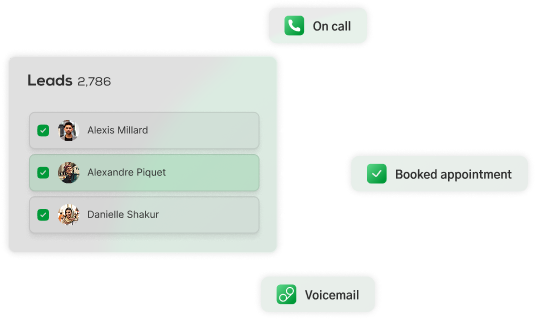
This is where telephony can play an important role. A CRM-connected phone system can automatically log:
- incoming or outgoing calls;
- date;
- time;
- contact;
- duration.
Agents no longer need to manually recreate every interaction. Depending on the solution, it is also possible to go further with:
- call recording;
- transcription;
- automatic summaries;
- conversation analysis;
- contact record enrichment.
Use AI to Reduce Data Entry
AI can be particularly effective in addressing the issue of administrative workload after calls.
Rather than asking agents to write a full call report, a solution can automatically generate a summary of the conversation. The agent can then review or complete the key information.
The goal is not to replace the agent's work. On the contrary: AI handles part of the documentation so agents can focus on the customer relationship.
Calls Are Not Just an Activity: They Are Sales Data
For a real estate agency, the phone represents much more than a communication channel. Every conversation can contain information that helps to:
- better qualify a prospect;
- identify an opportunity;
- personalize a follow-up;
- understand an objection;
- improve the customer experience;
- support an agent;
- manage sales activity.
The real challenge is therefore not simply to never miss a call.
It is to ensure that important information from calls is never lost.
A CRM-connected phone system combined with AI features can now automate part of this data collection and turn conversations into actionable data.
So, How Many Opportunities Is Your Agency Really Losing?
The answer is difficult to determine without analyzing your organization.
But you can start by asking yourself five questions:
- How many agents work at your agency?
- How many calls or customer conversations do they handle each day?
- Is important information systematically recorded in the CRM?
- Are follow-ups planned and tracked?
- Are calls automatically logged in your CRM?
The more often your agency answers “no” to these questions, the greater the risk of losing opportunities due to poor follow-up.
Key Takeaways
A missed call can cost you an opportunity. But forgotten information after a call can cost you many more.
The real challenge for a real estate agency is therefore to build a system where every important conversation can be retrieved, understood and turned into a sales action.
Unify your voice and data.
Test the power of connected telephony.

.png)
.png)
.png)
