
Omnichannel Customer Service: Definition, Benefits & How to Get It Right

A customer sends an email about a billing issue. Two hours pass. No reply. They call in. The agent who picks up has no record of the email. The customer explains everything from the beginning, frustrated, and hangs up before the issue is resolved.
This scenario plays out thousands of times a day across businesses of every size. And it is almost never caused by poor intent. It is caused by poor architecture. When communication channels operate in silos, customer frustration is not an accident. It is a structural inevitability.
Omnichannel customer service is the solution to that problem. Not adding more touchpoints, but connecting the ones you already have, so that every interaction builds on the last.
Here is everything you need to know: what it actually means, why it has become a baseline expectation rather than a competitive differentiator, and how to put it in place without overhauling your entire organization overnight.
Omnichannel, multichannel, cross-channel: clearing up the confusion
These three terms are used interchangeably in most marketing and IT conversations. They should not be.
Multichannel means your business is reachable through several contact channels: phone, email, live chat, social media. This is the most common setup. Each channel exists and functions, but they do not talk to each other. Every interaction starts from zero regardless of what happened before.
Cross-channel takes a step forward. Channels are coordinated to some extent. A customer might start a request on chat and continue by email. But the coordination is partial, often manual, and depends on individual effort rather than system design.
Omnichannel goes further still. The principle is straightforward: regardless of how a customer contacts you, every agent has access to the complete, real-time history of all previous interactions. The customer does not repeat themselves. The agent does not discover the file mid-call. Continuity is guaranteed by the system, not by people.
The distinction is not semantic. It is operational, and ultimately financial.
Why omnichannel has shifted from advantage to expectation
A decade ago, omnichannel customer service was the ambition of market leaders. Today, it is what customers consider the minimum.
Several converging forces have driven this shift. First, channel proliferation. Your customers already reach you by phone, email, WhatsApp, web form, social media and sometimes SMS. Every new channel added enriches the potential experience but increases internal complexity. Without unification, each new channel becomes a new source of breakdowns.
Second, rising impatience. The window customers consider acceptable between a request and a response has compressed dramatically. A customer who waited two minutes on hold does not understand why the agent picking up has no record of yesterday's email.
Third, the compounding cost of context breaks. Every time a customer has to repeat themselves, two things happen simultaneously: their satisfaction drops, and the agent's handling time increases. It is a double loss with every occurrence.
For customer service teams, building an omnichannel strategy is not a customer experience project. It is an operational efficiency lever with measurable returns.
The channels that make up an omnichannel setup in 2026
An omnichannel strategy does not mean being everywhere. It means being present on the channels your customers actually use, and connecting them. The main ones in most B2B and B2C environments are:
Voice/Phone remains the dominant channel for complex or urgent requests. When the emotional stakes are high, customers reach for the phone. The omnichannel challenge here is making sure every inbound call automatically surfaces the caller's full interaction history before the agent even speaks, regardless of what channel the customer used before.
Email retains its place for exchanges requiring a written record or a detailed response. It feeds naturally into a unified ticketing queue when the system is properly configured.
Live chat (on-site or via messaging apps) meets the demand for responsiveness without the friction of a phone call. It works particularly well for short requests and initial qualification.
Social media has become a genuine customer service channel, especially for public complaints. Leaving those interactions unanswered is not just a missed service moment. It is a visible one.
Self-service (dynamic FAQs, chatbots, customer portals) handles a growing volume of simple requests autonomously, freeing agents to focus on cases that genuinely require human judgment.
Integrating these channels into a unified view is what transforms a multichannel presence into true omnichannel delivery. For a deeper look at the underlying architectures that make this unification possible, the article on UCaaS vs CCaaS covers the difference between platforms built for internal collaboration and those designed specifically for customer-facing operations.
The concrete benefits of a well-deployed omnichannel strategy
Shorter handling times. When an agent walks into a conversation with full context, they skip the qualification questions. Average handle time (AHT) drops as a direct consequence. No process redesign required.
Higher first contact resolution (FCR). Without context gaps, agents address complete requests in a single exchange. FCR is one of the most closely watched metrics in customer service, and omnichannel is among the most reliable ways to move it.
Lower customer effort. The Customer Effort Score (CES) measures how easy it feels for a customer to get a problem resolved. The less they have to repeat, search, or wait, the lower the score. Research consistently shows CES correlates with long-term loyalty more strongly than satisfaction ratings do.
Better allocation of human resources. Self-service absorbs simple requests. Agents concentrate on high-value interactions. That is a gain in both productivity and meaning of work.
Richer customer data. Every interaction, across every channel, feeds a centralized profile. That data enables growing personalization and surfaces insights that inform management decisions rather than just intuitions.
The underestimated role of telephony in an omnichannel architecture
Phone is often the last channel to be connected in omnichannel projects. Teams invest in ticketing platforms, chatbots, and CRMs, then realize that phone calls remain outside the system: untracked, context-free, disconnected from every other interaction.
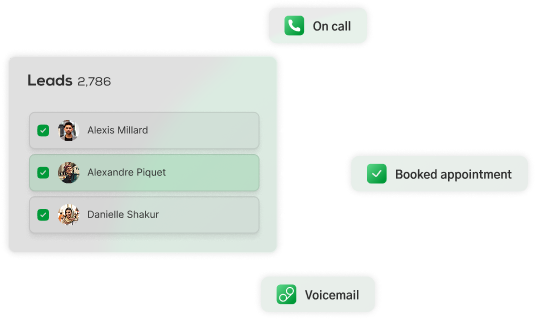
That is precisely where well-integrated business telephony makes the difference. When an inbound call automatically triggers the customer's full record to surface in the CRM, when the conversation is transcribed and summarized by AI, when the recording is accessible to the whole team for follow-up, the phone stops being an isolated channel. It becomes a functional link in the omnichannel chain.
AI features such as automatic transcription, sentiment analysis, and call summaries also allow structured data to be extracted from voice interactions, which until recently were entirely opaque to analytics tools. For distributed or hybrid teams where agents may be handling calls from multiple locations, this integration becomes even more critical. The article on hybrid work and unified communications explores how modern telephony infrastructure keeps customer data centralized regardless of where an agent is working.
What it takes to deploy omnichannel successfully
A CRM as the backbone. Every interaction, regardless of entry channel, must land in one central system. Without this foundation, unification stays partial. Telephony-CRM integration is usually the first project to tackle, because voice data is most systematically lost without it.
Intelligent routing rules. Omnichannel does not mean every agent handles every channel. Routing logic defines who handles what, at which priority level, within which response window. Getting this right is as much an organizational question as a technical one.
Agent training. Moving to omnichannel changes how agents work. They need to read multi-channel histories quickly, switch between channels fluidly, and rely on data rather than memory. This is a shift in working method, not just tooling.
Adapted metrics. Classic KPIs such as call volume and average handle time remain relevant but insufficient. Omnichannel demands cross-channel measures: overall resolution rate, repeat contact rate, average customer effort. Without these, it is impossible to assess whether the setup is actually working. The UCaaS comparison guide for 2026 is a useful resource for evaluating which telephony platforms provide the analytics depth an omnichannel environment requires.
What omnichannel is not
A few common misconceptions are worth addressing directly.
Omnichannel is not reserved for large enterprises. The tools that enable it are now accessible to mid-sized organizations, particularly through SaaS platforms that natively combine telephony, messaging, and CRM in a single subscription.
Omnichannel is not "automate everything." Automation is a possible component, not the goal. The objective is continuity of the customer experience. Complex, emotionally charged, or sensitive requests will continue to require a human agent. Omnichannel makes that agent more effective, not redundant.
Omnichannel does not fix broken processes. If your handling times are too long or your teams are understaffed, connecting your channels will not change that. Omnichannel amplifies what already exists. The foundations need to be solid before they are interconnected.
Conclusion
Omnichannel customer service is not a marketing promise or a technology trend. It is a structural response to a real problem: in an environment where customers move between channels without warning, businesses that force them to start over every time lose their trust and their time.
Deploying an omnichannel strategy means making an architectural choice: to place continuity of customer experience at the center, and to organize tools, data, and teams accordingly.
The phone is often the first channel overlooked in these projects. It is in fact one of the most strategic to integrate. It is where the most complex, most emotionally significant, and most information-rich interactions take place.
To discover how to deploy a conversational analytics strategy and unlock the full potential of your phone interactions : download our exclusive guide now: The Power of Voice: Optimizing the Customer Experience Through Conversational Intelligence.
Unify your voice and data.
Test the power of connected telephony.

.png)
.png)
.png)
