
The Real Hidden Cost of a CRM Disconnected From Your Phone System

Why Your CRM Is Lying to You: The Blind Spot Hiding in Your Sales Calls
Your CRM looks pristine. Client records are filled in, opportunities are qualified, reports run without errors, dashboards are green across the board. And yet the decisions built on that data stay approximate at best. Forecasts drift. Deals that looked safe collapse in the final stretch. Coaching conversations rely on hunches instead of evidence. The problem almost never comes from the CRM itself. It comes from what the CRM cannot see: the calls.
A phone system that is not natively connected to your CRM only ever shows you half your commercial reality. It records what a rep chose to type in, whenever they found the time, at whatever level of detail felt sufficient that day. Everything else, which is most of the actual activity happening on the phone every single day, exists nowhere at all. Not in a report, not in a dashboard, not even in a note. It simply evaporates the moment the call ends.
A full CRM is not the same as a reliable CRM
There is a comfortable illusion at play here. A CRM with every field populated feels complete. Stakeholders see clean pipelines, tidy opportunity stages, and a wall of "closed won" deals, and they read that as reliability. But completeness of structure is not the same thing as completeness of substance.
Manual entry is the first weak link in the chain. A rep who makes fifteen calls in a morning has neither the time nor the appetite to document each one with precision. They log the outcome, rarely the context. Objections raised, tone of voice, hesitation before a commitment, the exact phrasing a client used when they said "maybe": all of it evaporates the moment the call ends, leaving a CRM that is technically complete but strategically hollow.
This gap compounds over time. A rep's notes get shorter as their pipeline gets busier, precisely when detail matters most. Under pressure, "call went well, follow up next week" becomes the default entry for conversations that actually contained a half-dozen buying signals, or a half-dozen red flags, worth acting on immediately.
What this blind spot actually costs
This is not an abstract problem. Every hour of sales activity that escapes proper analysis carries a measurable price tag. It shows up as deals that get misclassified in the pipeline, as forecasts that miss because the qualifying conversation was never actually captured, as coaching sessions built on a manager's vague recollection of "how things sounded" rather than on what was actually said.
Multiply that figure across a full team and a full year, and a minor daily inefficiency turns into a real budget line for any sales leadership team. It is the kind of cost that rarely appears on a single dashboard, because it is distributed across dozens of small, invisible gaps rather than concentrated in one obvious failure.
The cost also hides inside team management itself. A sales director steering the team purely from what gets typed into the CRM is missing the activity signals that no CRM, on its own, will ever surface: talk time versus listening time, objection patterns that repeat across the team, response speed to inbound leads, tone shifts across a pipeline as a deal approaches its close date. Managing from incomplete data does not mean managing badly. It means managing partially blind, and mistaking a quiet dashboard for a healthy pipeline.
This blind spot also distorts coaching itself. A manager who wants to help a struggling rep improve their closing technique needs to hear the actual call, not a two-line summary written under time pressure. Without that raw material, coaching becomes generic advice detached from what actually happened on the line, which is a large part of why so much sales coaching fails to move the needle.
Turnover makes the blind spot permanent
The sharpest version of this problem shows up when a rep leaves. Without a real connection between the CRM and the phone system, most of the relationship history with a client lives in that person's memory, not in a record the company actually owns. When they walk out the door, so does the context behind every deal they touched: the objections already handled, the promises already made, the tone that got a client to say yes, the small personal details that turned a cold account into a warm one.
Their replacement inherits a CRM record and a blank slate everywhere else. They have to rebuild trust and context from scratch, often while the client silently compares the new rep's grasp of the account to the one who just left. This is not just a knowledge management problem. It is a direct hit to onboarding speed, to client retention, and to the revenue that depends on both.
Why this happens even in mature sales organizations
It would be easy to assume this only affects smaller or less disciplined teams, but the opposite is often true. The more successful a sales team becomes, the more calls it makes, and the wider the gap grows between call volume and what actually gets documented. Growth does not fix this blind spot. It amplifies it, because the volume of undocumented activity scales with the size of the team, while the time available for manual entry does not.
Even well-run organizations with strict CRM hygiene policies run into the same wall eventually, because the constraint is not discipline. It is the physical impossibility of a human accurately transcribing, contextualizing, and tagging every conversation they have while also actually selling.
What a native integration changes in practice
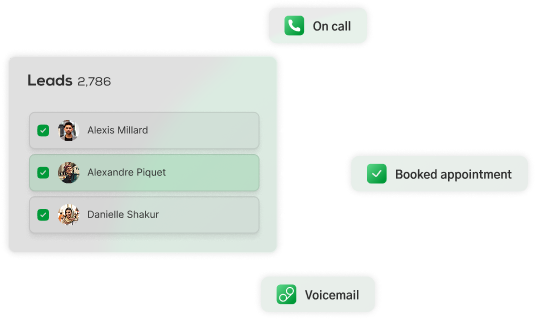
A native integration, the kind Un1ty provides with 3CX, Teams Phone, or Webex Calling, reverses this logic entirely. Every inbound and outbound call attaches automatically to the correct client record, with zero manual entry required. Recording, transcription, and AI sentiment analysis enrich the CRM in real time, turning every conversation into structured, searchable data instead of a memory that only exists in one person's head.
This is also where the qualitative layer becomes usable at scale. Instead of relying on a rep's subjective read of "how the call went," sentiment analysis gives sales leadership an objective, consistent signal across the entire team, call after call. A manager no longer has to choose between trusting a two-line summary and listening to hours of raw recordings. The system surfaces what matters: which calls carried hesitation, which ones carried genuine enthusiasm, which ones need a manager's attention today rather than at the next pipeline review.
It also changes what happens the day someone leaves. Instead of a departure erasing months of relationship history, the full record, calls, sentiment, transcripts, context, stays exactly where it belongs: inside the company's own systems, accessible to whoever picks up the account next.
Where to start
Before changing tools, it is worth measuring the scale of the problem you actually have. How many calls currently escape your CRM every week? How much time do your reps burn re-typing manually what should already be automatic? How many coaching conversations are based on a summary rather than the actual call? These three questions alone tend to reveal a gap most sales leaders underestimate until they see the number in front of them.
Un1ty offers native phone-to-CRM integration built to eliminate this disconnect at the source.
Request a free demo to see what it would change for your team.
Unify your voice and data.
Test the power of connected telephony.

.png)
.png)
.png)
